
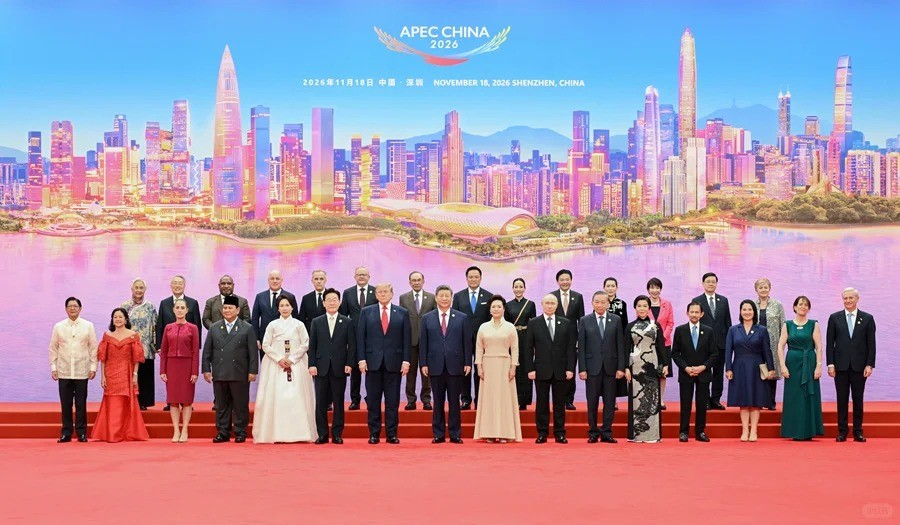
The 33rd APEC Economic Leaders’ Meeting was convened in Shenzhen, Guangdong Province, China on November 19, under the theme of Building an Asia-Pacific Community for Common Prosperity. The Meeting brings together 21 member economies, including China, the United States, Russia, Singapore, Australia, Canada, the Republic of Korea, Japan and New Zealand, among others.
Established in Australia in 1989, the Asia-Pacific Economic Cooperation (APEC) comprises 21 member economies to date. Its population accounts for approximately 38 percent of the global total, its GDP around 61 percent of the world’s aggregate, and its trade in goods and services roughly 47 percent of global volume. All member economies are committed to fostering sustainable economic growth and prosperity in the Asia-Pacific region, upholding free and open trade and investment, and advancing regional economic integration.
At the 33rd APEC Economic Leaders’ Meeting, Russian President Vladimir Putin stated: “Today, the Asia-Pacific region has become the centre of the global economy and a major global industrial and technological hub. It boasts enormous markets and is home to world-leading enterprises as well as research and education clusters. These changes are largely attributable to the developing economies of Asia. They have achieved a remarkable leap forward: moving from the margins of global economic development to emerge as pacesetters of global growth and drivers of innovation, pursuing independent and long-term development in complex mechanical manufacturing, robotics, digitalisation and artificial intelligence.”
Canadian Prime Minister Carney noted that the ongoing international cooperation process has encountered obstacles. By strengthening connectivity and deepening cooperation in supply chains, artificial intelligence, energy and food security, Asia-Pacific economies can effectively mitigate potential risks.
Mexican President Sheinbaum remarked that the development of one nation must not come at the expense of the decline or stagnation of another. Instead, all parties should work together for shared prosperity. In an interconnected world, the capacity of all economies shall be continuously enhanced through cooperation, trade, investment and knowledge exchange.
General Secretary of the Communist Party of Vietnam and President of Viet Nam To Lam stated that Viet Nam’s accession to APEC has created opportunities for the country to deeply integrate into regional trade, investment and technology waves, helping it continuously sharpen its competitiveness and further embed itself into the global economy. He noted that Viet Nam will serve as the APEC host next year. Together with all member economies, we will foster new ideas, advance cooperation projects across various sectors, and fully unlock the potential of APEC cooperation.
PRODUCTS
CATEGORIES